
Marketing automation
Froda sends automated messages that follow the customer through their journey, timed to nudge them toward the next useful action and cut down on people dropping off along the way. Instead of sending the same thing to everyone, each message is triggered by where a customer actually is, what they've done, and how much risk their situation carries. The exact journey looks a little different depending on the product and the partner setup, but the underlying idea stays the same everywhere.
The loop behind every message
Something happens
Work out where the customer is
Send the right message
Prompt the next action
Adjust based on what happens
The exact trigger and message differ by product and by moment, but every automated send follows this same shape.
Three areas this covers
Getting the application finished
Messages triggered once someone has started or submitted an application, aimed at helping them finish it instead of dropping off partway through.
Confirming what happens next
The important updates: approved, rejected, or money on its way.
If a payment is missed
Automated follow-ups after a missed payment. How soon they start and how strongly they're worded can depend on how risky the situation looks.
For embedded partners, this is an opportunity, not just a Froda job. Froda's product-triggered messages can be paired with your own CRM, in-app messages, and marketing channels, so the customer experiences one coordinated journey instead of two separate companies emailing them about the same thing.
The goal isn't "more emails." It's making sure the customer gets the right message, from the right sender, at the right moment, with an obvious next step.
Example: getting an application finished
Two real examples, Ageras and Visma Invoice Financing, follow essentially the same shape:
| Where the customer is | What the message needs to do | What it actually says |
|---|---|---|
| Application submitted | Confirm it was received and remove uncertainty | "Thanks for your application," what happens next, and how long a decision usually takes. |
| Application incomplete | Bring them back to finish it | "You're almost there," what's left to do, and a button back to the application. |
| Still incomplete | Make the one missing thing impossible to miss | "One last step," spelling out exactly what's needed. |
| Rejected | Close it out clearly and respectfully | An explanation that the application can't go ahead, plus any relevant next steps. |
| Approved | Confirm the good outcome | A clear confirmation that the financing is approved. |
| Money on its way | Set expectations | "Your money is on the way," when it'll arrive, and what happens after. |
| Timed out | Either close it or leave the door open | A final nudge, or a note that they can pick it up again later, depending on the setup. |
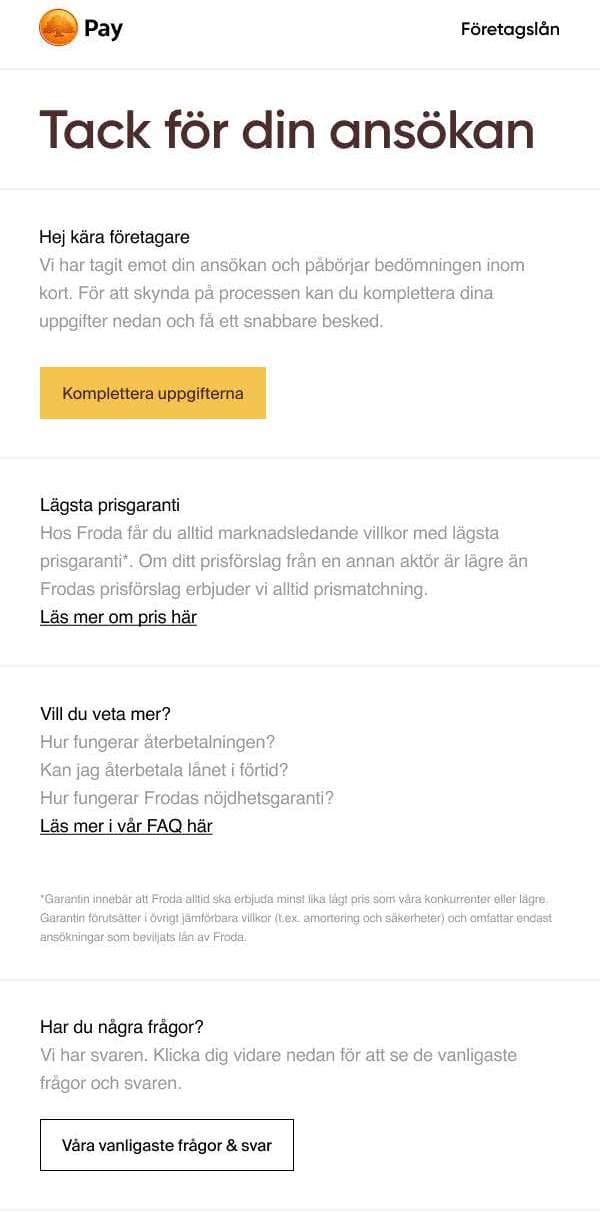
What these emails contain
Where things stand
What's happened, or where the customer currently is: "Your application has been received," "You're almost there," "One step remaining."
Why they're hearing from us
A short explanation of why this email landed in their inbox, and what's missing.
What to do next
One clear, hard-to-miss button: continue the application, complete the missing information, log in.
What happens after
What happens once they've done that, including roughly how long it usually takes.
The further someone has gotten, the more specific the message gets. Instead of repeating "finish your application" every time, later messages name the exact thing that's still missing.
Example: if a payment is missed
There's a second layer of automation once financing is actually active. A missed payment starts a sequence of follow-up emails. How soon the first one goes out, and how many follow, isn't necessarily the same for every customer: it can be adjusted based on how risky the account looks. The exact timing varies enough between setups that it's not worth treating as a fixed rule. The stronger principle is to let the customer's risk and payment history decide when and how strongly to escalate, not a single calendar for everyone.
Inform
Let them know a payment appears to be missing, give them an easy way to sort it out, and share how to get in touch if something's wrong.
Remind
State plainly that it's still outstanding, make the required action explicit, and explain how to fix it.
Urge
Point out it's still unpaid, note that further steps may follow, and give a stronger call to pay or get in touch.
Escalate
Be direct about how serious it is, explain what happens next if it isn't resolved, and give one final, clear way to act.
Inform → remind → urge → escalate: the tone builds with every message, not just the timing.
Bringing this into your own activation plan
Build around real customer behavior and financing status, not a static send calendar. Identify the moments that matter in your own journey, and define, for each one:
| What triggers it | What the customer needs | The message | Channel | Next action |
|---|---|---|---|---|
| Application started | A reason to keep going | Remind them why the offer is worth finishing | Email / in-app / push | Continue |
| Application incomplete | Clear guidance | Explain exactly what's left | Email / push | Complete application |
| Application approved | Confidence | Confirm it, and what happens next | Email / in-app | View offer |
| Financing paid out | A confirmation | Confirm the payout | View financing | |
| Eligible again | A reason to come back | Point out the renewed opportunity | Email / in-app | Explore financing |
| Payment missed | A clear path to resolve it | Explain the situation and what to do | Email / SMS | Pay / get in touch |
| Strong usage or a good outcome | A reason to grow | Surface a bigger or additional opportunity | CRM / in-app | Explore more |
Froda's messages and yours
The most powerful setup probably isn't the partner replicating every Froda message. It's each side doing what it's best placed to do:
Froda
Handles the messages that are critical to the product and required by regulation: the ones that have to be right and have to be sent.
You, the partner
Bring your stronger relationship with the customer and your own channels, and use them for the moments where a nudge from you actually increases conversion or usage.
Together
The two journeys should feel like one coordinated conversation, not two companies separately emailing the same customer about the same thing.
It depends on your platform
This isn't one-size-fits-all. A bank, an accounting platform, a marketplace, and a payments provider all have a different relationship with their customers, different signals to work with, and different natural moments to activate around, so this should adapt to your context rather than follow one universal journey.
Accounting platforms
Can trigger around things like a new invoice, cash-flow patterns, or everyday bookkeeping activity.
Marketplaces & payment providers
Can trigger around sales volume, seasonality, or stock levels.
See Guide per partner type for how each context differs in more depth.